Separator

Separator
Showing posts with label South Korea. Show all posts

Thursday, 18 December 2014

The quest for the perfect Glühwein

It's time for mulled wine and gingerbread and we spent the past weekends benchmarking different spots in Seoul where one can fight the freezing cold. We started two weeks ago in the European Christmas market, in Seongbukcheon Fountain Square, a joint effort from several European embassies. The mulled wine was nothing to write home about (almost bitter tasting), but anyway, we are in Seoul, right?
Seongbukcheon Fountain Square
The square was too small for so many people but we found a tiny empty corner close to the Christmas tree to drink our Glühwein and eat our rösti, which was selling like hot cakes, despite some cooking flaws!
Seongbukcheon Fountain Square
To be honest, we were so disappointed with the Glühwein that we went straight to the German pub Zum Hirsch in Itaewon. Their Glühwein was what is supposed to be, spiced and fruity, fragrantly sweet. We had a winner! We accompanied it with a potato salad. Not a usual combination, true, but the only other vegetarian option was fries...

Glühwein, Zum Hirsch, Itaewon
Last weekend, after missing the French Christmas Market, which closed at 4pm (really?), we went to the German Christmas Market in the German School in Hannam-dong. Funny enough, it opened at 4:30pm and closed at 8pm, a tad more adequate to our Portuguese weekend schedule. We had a very decent Glühwein, which made the -10º C that evening feel like -5º C. The gingerbread was also more on the perfection side. 

Glühwein, German Christmas Market
We finally tried the doenjang bibimbap in 툇마루 restaurant in Insadong. It's soul food, home-made and it tastes great. The banchan are not vegetarian though. You get all the ingredients on the table and then it's DIY: put the lettuce and chives on top of the rice, together with the fermented bean paste and tofu. Mix and this is the result:
된장비빔밥, Doenjang bibimbap
The rest of the week we spent it trying no to fall in the street. With the freezing temperatures the whole city is a giant ice rink. Koreans are pros - they keep running (they are always running somewhere) and I haven't seen a single one fall down.
Hannam-dong
But now it's time for... bolo rei! Europe, here we come!

Thursday, 27 November 2014

“Autumn leaves” II and soul food

Three weeks ago we went to Pureun Arboretum near Onsu Station (Exit 3, Lines 1 and 7) for some more autumn photos. The minibus number 07 links Onsu station with the rear entrance of the Arboretum but the distance is also walkable (around 1 Km) – just follow the signs. We were blown away with such intense colours.


It has several theme gardens (rose, maple, hibiscus, herb, vegetable etc.), with both Korean plants and from around the world, spread in an area of more than 100,000 m3. The main attraction for us was the old railway track on which you can promenade.

Old train track
Another reason to like autumn in Korea is that 호빵 (steamed buns) are back. We love the sponginess and the "smoking hot" red bean. There are other fillings, ok... but we only buy with red bean filling (팥호빵).
Hobbang (호빵)
Another breakthrough in the baking field is that we finally managed to get to May Bell bakery, twice! This bakery in Itaewon is one of a kind and every single Seoulite knows it. Interesting facts: it opens at 11am (yes, I wrote bakery!), and closes as soon as they run out of bread, which happens around 2pm (yes, 2pm). Customers start queuing outside even before the opening time, which makes buying here a great challenge.

We had to queue both times, and there's a lot more choice if you're among the first customers. Getting there is so hard that people buy in quantity. This place’s secret is not only quality ingredients but also lower prices when compared to other bakeries. Our favourites: multigrain bread, fig rye bread, cranberry rye bread and the red bean and walnut bread. The focaccia and the baguette are also good but not our favourite types of bread. Our priority is ALWAYS to stock up on read bean bread!

Red bean bread galore
Meanwhile Sambazon (the açaí bowls shop) has opened and we tried it last Saturday. They have three sizes: small (cup), regular and large (bowl). The one in the picture is the regular size (7,500 won). It's packed with tasty fruits (mango, kiwi, blueberries, banana, dragon fruit), chia seeds, goji berries, and further greatness. Hard to believe that a shop like this can survive by only selling açaí, but anything can happen in this fast-paced market.
Açaí bowl
Also on Saturday, and because the days are cold enough, we went to Daejong Sundubu for some heartwarming uncurdled tofu stew. They make their own tofu and, in our opinion, this is one of the best 순두부찌개 in Seoul. The banchans are also delicious and they brought us a refill without us even having to ask for it!

Uncurdled tofu stew and side dishes
정말 맛있어요 (really delicious)!

Friday, 7 November 2014

"Autumn leaves" and nostalgic eats

Autumn has made a hard landing here in Seoul, knocking out our sweet Indian summer. We took a walk up to Namsan mountain last weekend and pictured some amazing colours:


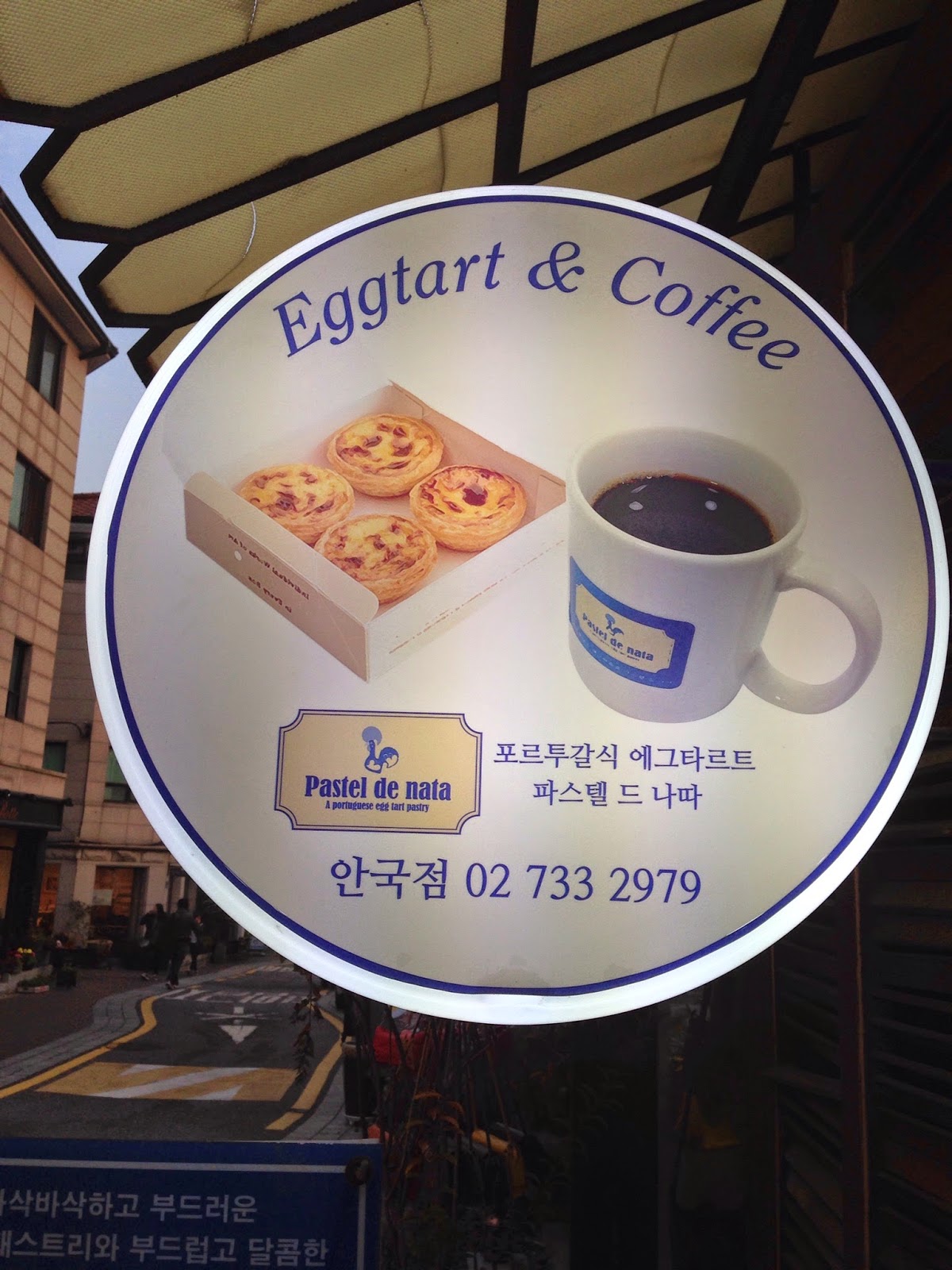
We have also discovered in the meantime that it's possible to buy Portuguese egg tarts (pastéis de nata) in Seoul. In fact there are several locations where they sell them. Although we do not crave the tarts that much, the discovery made us happy for some underlying nostalgic reason.

Portuguese egg tarts in Anguk-dong
Pastel de nata (egg tart)
We tried the shop in Anguk-dong. They not only have the classic egg tart, but also a few non-Portuguese variations: chocolate, walnut, apple cinnamon, lemon, pumpkin and sweet potato tarts. Price per tart is 3,500 KRW. Classic is 2,200 KRW.

To get there: from exit 1 in Anguk station, turn right and immediately right again. The shop will be on your left roughly 200 meters up the street.

This combined with the Manoel de Oliveira Retrospective being shown at the moment in Seoul Cinematheque makes 10,000 kilometers seem a hop, skip and a jump.

The cherry on top of the tart was finding out almost simultaneously that we will soon be able to eat  "açaí na tigela" just next door from us (Itaewon-ro 54-gil).

Açaí bowls: opening soon in Itaewon
Ok, we will not go wild on the açaí because we don't want to contribute to the Amazonian deforestation, but at least, Autumn just got a tad more interesting!

Tuesday, 23 September 2014

Trip to Busan: The Chuseok experience

Our first Chuseok, aka Korean Thanksgiving, was like a box of songpyeon... we didn't know what we were going to get!

We had a couple of friends visiting from Europe and we wanted to go south with them for the long weekend. However buying train tickets (even if a month in advance) proved to be a serious endeavour cause everyone else wanted to go somewhere as well:

Seoul Station at 9am on the day train tickets became available
As a celebration of the good harvest, Koreans visit their hometowns during Chuseok and share traditional food and drinks. Everyone was going to be on the move and we were joining the flow. We finally managed to book the tickets online but only from Monday to Wednesday. Busan was the destination! At least we knew there would be shops and restaurants open for business.

I started the preparation for Chuseok by attending a songpyeon (small rice cakes with sweet fillings) making class. I was told to eat this traditional Chuseok treat within 24 hours otherwise I would have to freeze and re-steam them. No need to say that the steamer never left the kitchen cabinet.

Songpyeon
Seoul was not as empty as I thought during the weekend of Chuseok, so I hoped that the same would apply to Busan for the rest of the holiday. We boarded the train early on Monday and, to my surprise it was not full. We checked in the hotel in Haeundae and went to the beach. The water was cold but bearable after a few minutes of prep work, limb by limb.

We had dinner in the fish market on the eastern side of Haeundae beach. Tasty but no frills. There's a huge construction site near the market and to embellish the area they put up some photo backgrounds on the fences. We couldn't resist this one:

The BIFF red carpet (*cough*)
He had planned a hike in Geumjeongsan for the following day and according to the information in our guidebook, the level of difficulty was quite acceptable so I took my plimsolls thinking it would be like a walk in the park. We stock up our backpacks with red bean buns from a bakery close to the hotel and off we went…

Lesson learned for life: I will never ever climb a hill in Korea without trekking shoes.

The hike took us at least four hours and included going up to the wrong peak (me asking a Korean couple where was the “mountain” instead of the “peak” didn't help – lousy guidebook!), steep and rocky stretches and constantly being taken over by Koreans, who by the gear they were wearing, seamed they were ready to climb the Himalayas... very expensively!

We still had lovely views from the mountain:

Geumjeongsan
And managed to get to the right peak thanks to a group of Korean hikers, who we followed gladly for a while, after coming down from the wrong mountain.

Godang-bong peak
We were tired therefore we deserved a reward dinner to lift our spirits. We ended up in the Millak Hoe Centre (raw fish market) in Gwangalli Beach.

Raw fish restaurant (Millak Hoe Centre)
We went to the beach the next day, just before the checkout. It wasn't as crowded as on the main Chuseok day and we were glad for that. After checking out we headed to the city centre and had lunch close to the Jagalchi fish market. Our friends left to Namhae and we went to Gwangbok (Independence) Street and the Yongdusan Park before taking the KTX back to Seoul. We still had time to go and try the famous pajeon (green onion pancake) in Dongnae before leaving.

Mushroom pajeon and banchan
Masitkke deuseyo!

Tuesday, 5 August 2014

Donghae: Weekend at the East Sun

Summer weekend at the beach! Or at least we thought until we saw the weather forecast a few days before leaving to Donghae. Even after hearing about the typhoon alert we left with hope that it would somehow improve over the hours.

We took the express bus from Seoul’s Gangnam Terminal, but soon discovered that the bus was not express at all. It took us 5 hours to get to the coast. The driver left the highway a couple of times to escape the traffic jams and ventured in the hilly countryside, through roads where I thought impossible to maneuver with a bus.

An overcast sky welcomed us to Donghae. We took a taxi to the hotel, which was located in Mukho. I was planning to get a lot of information from the hotel’s front desk but soon realised that I was not going to speak any English there. As our Korean is limited to say the least, we resigned to communicate via Google translate… or not at all.

The Donghae Beach Hotel is misleading in many ways: it’s not located in Donghae but Mukho; it’s at the seaside but not at the beach, and resembles more a typical Korean motel than a hotel. It was in desperate need of renovation. I’m almost tempted to forget the writing for the web guidelines and write “desperate” in red, capital letters and underlined.

There were two pieces of cloth and a plastic basin in the bathroom which puzzled me (!) and the hotel’s towels were charmingly drying in the hallway, in front of the lift. However the highlight of this hotel was actually cute in a very twisted way: the “punk little creature” that was guarding the entrance.

Funky Yorkshire terrier at the reception
We grabbed our flip-flops and left to the beach. We kept on walking along the coast until Mangsang, one of the most popular beaches in Korea. On the way we learned about the beach habits of Korean families and what they need.

1. Tents – either the family tent to spend the day or the store tents, to buy all the forgotten items:

"Living area"
"Shopping area"

2. Life-jacket – in case one forgot, they were also being sold a few meters away, in the main street:

Life-jackets for sale!
3. Food – very important and we should actually thank the kindness of the lady who shared with us a steamed corncob. The friendliness of Koreans doesn't cease to amaze us!

Barbecue time!
4. Floating tubes and various water sports, including surf:

Tubes away!
Surf class
Koreans protect themselves from the sun and many of them go to the water fully dressed. We were probably the only cowards who didn't wet more than the feet because we thought the water was freezing (it was! I come from Porto, remember?).

What should be written in many websites about visiting Donghae is that a big stretch of Mangsang beach is a military area and cannot be accessed. Signs are only in Korean and if it wasn't for the surf instructor warning us, we would have caused a big hassle among the young Korean military playing water polo!

Our dinner was in a fish restaurant. Our hotel was located in the so-called “sashimi town” and we just entered one randomly until we realised that nobody spoke a word of English. Fortunately there was a customer in the restaurant who spoke some English and helped us with the order. We had: fried mackerel, seaweed soap, banchan, sashimi plate and fish soup at the end.

Masit-sseoyo!
Our plan was to go to Mureung valley the next day but as soon as we woke up we saw the rain pouring down non-stop. We decided to change our tickets and take the bus back to Seoul earlier than planned. We thought that we would avoid the traffic by leaving early in the afternoon.

Our learning curve in Korea is quickly accelerating: it took us 7 hours to reach Gangnam. We have definitely parted ways with express buses in Korea. Annyonghi heseyo!

Thursday, 24 April 2014

Food for the Seoul

Street food in Seoul is a treasure hunt. You go from stall to stall and try different flavours done with different, but precise techniques. Many are actually sweet – newsflash: we will not leave this country without getting type 2 diabetes – but interesting nevertheless. Street food snacks range from:

- egg bread (gyeran ppang)


- deep fried dumplings filled with sugar, honey, nuts and cinnamon (hotteok)


- spicy rice cakes (teokbokki)


- fish cakes (odeng)

- various foods on a skewer (kkochi)


- deep fried vegetables (twigim)

- pancakes (jeon)

- dry octopus and squid


- rice rolls (gimbap)


I don't have pictures to illustrate them all but will definitely update this post with more pictures as soon as I buy the next yummy snacks.

One can easily have a full meal going from one stall to another. No language skills are needed here. Money does the talking.

Some stalls cater for office people and close late afternoon. It's very common to see businessmen and women in dark suits holding their fish sticks and hanging out around a stall just after leaving the office.

Other Koreans put up their stalls around 5pm in busy areas, especially where nightlife is bustling – such as Hongdae (the university neighborhood) and Myeongdong (Seoul’s shopping haven).

In Namdaemun market, since they are more used to foreigners and especially when the business is slow in the evening, they even call out for us. In other parts of town, mainly in Insadong and in Hongdae, where for the first time in my life I was stuck in a queue to get into the subway station, they couldn’t care less.

In Gwangjang market they even have specific alleys according to the type of food – pancakes, meat (including pig trotters, yes, pig trotters), sashimi / seafood and so on… It’s so crowded that we had to queue for at least 10 minutes to buy two bindaetteok (see pic below). The place was so full that the ajumma waiting tables was pushing everyone in her way to get through. "Excuse me" is not something you hear often in Korea, even though they behave orderly, generally speaking. 

Gwangjang Market
No matter where you are in Seoul, if you have a couple of won in your wallet, you won’t go hungry.

Friday, 28 March 2014

Geonbae! Cheers!

It’s drinking time!

All the imported booze is heavily taxed in Korea which makes drinking wine a luxury, especially in restaurants, where bottles can easily cost you 50 to 60 USD (50,000 to 60,000 Korean won). Spirits... don't even mention it! On Saturday we were in a Mexican restaurant where they charged almost 20 USD for a Margarita! Surprisingly the food was one of the best we have had in international restaurants.

The Korean products are on the other hand extremely cheap. One bottle of soju in the supermarket costs around 1USD. The bottle of makgeolli is a bit more, but less than 2USD. So getting drunk is not a difficult task, as long as you grow fond of the taste of Korean beverages, which believe me, is pretty far from what we are used to.

MakgeolliWikipedia: Soju

Soju has a very plain grainy taste and the high alcoholic content is all you feel burning your chest when you gulp it down. Makgeolli – made from a mixture of wheat and rice – has a milky appearance and can be more interesting when perfumed with spices (cinnamon, ginger) and fruits (apple, orange).

Getting drunk is something normal but only among men. They drink together, mostly in the evenings, after leaving the office, and drag themselves in the streets afterwards, sometimes singing while hugging each other.

One hardly sees a woman drunk, except in Itaewon, the international area, though rarely. But when I say drunk, I say dead-drunk, which is a state they easily attain after two beers. :) Lack of the necessary enzymes to break down the alcohol.

A useful service has been gaining ground in Korea – the designated driver service, which you can call in case you had a bit too much to drink and want to be driven home in your own car. An estimated 100,000 replacement drivers tend to 700,000 customers every day across the country. This number increases by 30 % on Fridays (source: Korea Service Driver Society). In a 50 million people country, this is a significant number.

Thing about drinking in Korea is this: even if they drink a huge amount of booze they still maintain themselves morally sound. The drunk foreigners are the ones doing mischief.

Next post will be about food – street food, yeah!

Tuesday, 18 March 2014

Wiki Korea

It has been an interesting few weeks. I'm now feeling more hopeful regarding communication with Koreans, but probably I have taken my gesture skills to the next level in the meantime. And Google Translate has given me a hand.

I’m amazed with how much communication can take place with only a few gestures and words like:

  • “spicy” – that’s the warning I get whenever I buy kimchi here, and then I'm asked if I wanna take it in the airplane (is that even possible? not only the because of the smell, I mean, there's still a lot of liquid inside!),
  • “on / off” – very important when I have technicians coming to fix / handle appliances at home,
  • “ice / hot” – whenever I order a coffee, tea or latte in a coffee shop I’m always asked if I want it iced or hot, even if it’s -10 degrees outside,
  • “sign / no sign” – debit cards don’t require pin numbers in Korea. 3 out of 10 times I don’t even need to sign, which makes losing the card a big risk; on the other hand, it’s one of the safest places I've been…

Everything is high-tech and loud. There are tv screens everywhere and appliances produce annoying long-lasting sounds to indicate errors or that the programme has ended. Every time, the ATM and the metro card reload machine scream at me with instructions in English and I don’t know how to make them stop. And the voice in English sounds so much louder than the Korean. Almost as if foreigners needed extra encouragement.

Keys have no use in Korea. Everything works with codes, including our apartment door:


 Our living-room looks like a control room:


Everyone carries a Samsung Galaxy Note, though some lost souls try to stand out of the crowd with an iPhone. Since its launch, 10 million Notes have been sold in Korea alone. Most of the technology in public places is powered by Samsung. Our home is powered by LG (ok, except the microwave and the TV).

The banking system is pretty advanced in some things like paying bills by only scanning a QR code and so behind in others – I still had to go to the counter to change my card’s pin code (yes, the one I never use).

In the meantime we have found a little Portuguese oasis in Hongdae, the university area – the first and only Portuguese restaurant Taverna de Portugal with Super Bock beer and homemade “pastéis de nata”, yeah! It's run by a Portuguese-Korean couple and will be our safe haven whenever we feel homesick and need to speak Portuguese to someone other than ourselves. Difficult task, since there's just a few over 100 Portuguese in the whole country...


마포구 상수동 90-8

Another nice thing I've discovered this week: Spring is coming!

Hannam-dong, Seoul

Tuesday, 4 March 2014

Goodbye Brussels… hello Seoul!

I should have written this post a long time ago but moving leaves little time to stretch the mind. I feel I should honour the city where I lived for almost 7 years with some words.

Even though at first glance Brussels can be disappointing it grows on you and once you discover its hidden secrets, it’s hard not to like it. The only thing I’m happy to leave behind is the bad customer service, with a few exceptions.

My last days in Brussels were kind of emotional. I’ve tried to go to the places I like the most. The only miss was this sneaky Japanese restaurant in St Catherine – there’s only one living person I know who has actually made it there. It’s always full and they make it clear by having a “complet” sign on the door… all the time!

Otherwise, I went:
  • one last time to the opera in La Monnaie and saw Jenufa with friends, after which we had a beer in the historic brasserie Le Cirio
  • one weekend to Porto to celebrate my parents’ birthdays. Thank you Ryanair for helping with last minute decisions!
  • to the El Dorado room in UGC De Brouckere to watch 12 Years a Slave and to Actor’s Studio to watch La Grande Belezza.
  • to eat “moules and frites” in Le Pré Salé in rue de Flandres. Best mussels in Brussels, by the way.
  • to Nespresso at least twice to bag as many capsules as possible to bring to Seoul – it’s a highend product here, not to talk about the Starbucks latte at 6,5USD.
  • to Inno department store to stock up with clothes – fashion in Seoul is peculiar to say the least, although I’m finally in the land of extra small sizes, oooray.

For my last lunch in Brussels we ordered Turkish pizza, delivered in the office. We accompanied it with French wine and a lively discussion about curling while listening to Gangnam style and Silvio Berlusconi, alternatively.
Cheese pide


The “apero” later that evening was in a brand new restaurant / bar called Beaucoup fish. It’s worth a try and the way they bring the bill is kind of funny, at least for a Portuguese.

Tuna can Bom Petisco (PT)

So hard to say goodbye to friends.

My last morning was a mix of different feelings but sadness was the strongest. I was taken to the airport by an extremely nice Rwandan taxi driver, but didn't leave the country without having an altercation, this time with the staff at the check-in counter. This is Belgium!