Separator

Separator

Wednesday, 4 March 2015

Skiing in Niseko, Japan: the powder dilemma

We wanted to begin the Lunar New Year in style and speed, so Niseko seemed to be the obvious destination for one reason: powder! It advertises itself as having some of the best powder ski in the world and it’s just next door – what else could we look for?

We packed heavy – fleeces and socks galore, balaclavas, masks – but didn't get to wear half of it. Siberia tricked us big time, and instead of having a big mass of cold air, we got sunshine and rising temperatures instead. First time I cursed against a clear sky!

Annupuri Ski Resort
Niseko is made of 5 different ski resorts: Annupuri, Higashiyama (aka Niseko Village), Hirafu, Hanazono and Moiwa. All of them are linked but only the first four are included in the All Mountain Lift Pass. We stayed in a lodge right off the slopes of Moiwa, but spent only one day skiing there. The rest of the time, we skied in Annupuri and Niseko Village.

Moiwa Ski Resort
Some who had skied there before were praising the weather and the mountain top being open. Others, like the powder-hungry skiers in our lodge, were disappointed with the icy snow and simply stopped skiing. We embraced the dilemma, and enjoyed some powder-less skiing with a powerful sunshine. The downside of it all was the dangerously icy sidewalks – our legs flew in mid-air a couple of times.

Annupuri Mountain top
There’s little Japanese in Niseko in general. The place is so popular among Australians, Singaporeans and European expats, that it becomes a real challenge to hear any Japanese on the slopes, except for the staff managing the chairlifts and gondolas. This could be the toughest level of the “Marco Polo” game, ski slope version. Hirafu is the most international area, where the most restaurants and bars are also located. If not staying there, be sure to arrange transportation back to your hotel. Taxis are limited and normally take at least 20 minutes to arrive after calling.

Mount Yōtei
We were kind of suspicious when we heard some people saying that they had booked restaurants already in November! We took a Portuguese approach and never booked anything. The only time we had a table booked was in Hirafu and we had called the restaurant one hour before – pure luck, ok, but we proved wrong the pessimism of our front desk staff... at least once, yeah!

There is a restaurant though for which you REALLY (but really!) need to book in advance: Sobatei Rakuichi, in Annupuri. The place is tiny, only with seats at the counter, but it serves the best soba in the area, which by the way is kneaded and cut in front of you. They only accept reservations for dinner which means that you can still try your luck and queue up at lunch time – expect a 30 to 45 minutes wait, unless you have some kind of lucky charm. They open at 11:30 for lunch.

Sobatei Rakuichi
In the future, if someone asks us what’s better, powder or sunshine, we say: hot soba!

Since we were staying in Moiwa, we took the opportunity to try the mixed onsen of the Niseko Grand Hotel. It’s the only mixed onsen in the area. You pay 800 yen per person at the hotel reception and then head toward the locker room. Small and bath towels are also available for a small price at the reception and women can also rent a yuami – a special garment to wear in the mixed onsen. Besides the mixed open-air onsen, there are also women-only / men-only hot bath areas. It was one of the few places in Niseko where we could remind ourselves that we were still in Japan! The majority of the people there were Japanese men, accompanied by their longtime friend, the Asahi beer can.

We spent the last two days of our holidays in Sapporo, which might not seem so captivating at first glance, but as soon as you discover that beer is sold at 200 yen in the Sapporo Beer Museum, well... it just gets a tad more interesting! Sapporo may not be the nicest Japanese town, but the river Toyohira cutting it in half and the surrounding mountains create an exceptional natural environment, and spectacular views! It's still possible to spot foreigners, but not as easy as in Niseko.

Sapporo
Japan never ceases to surprise us: albeit its fast-pace, innovative society, traditions are still paramount, at the table or at the onsen. This was quite obvious during this trip. And, who could expect to find the most international place of all Japan on the farthest-north island of the archipelago? Were we disappointed? No way! Despite some thorns, Japan still makes our curiosity bloom.

Friday, 30 January 2015

What lies at the end of the rainbow?

The Palauan islands are described by their nationals as “the end of the rainbow” and they are not very far from the truth, although pretty far for almost everyone else on the globe. Luckily, for us it was a mere four and half hour flight.

Palau is not so much a beach destination as it is a divers’ paradise. Most hotels and resorts are gathered on and around the island of Koror, which is itself and like most of the Palauan islands: rocky! The islands in the Southern Lagoon on the other hand, have nice white sand stretches, but imply a boat ride of at least 45 minutes from Koror.
One of the beaches in the Southern Lagoon
Our trip to Palau lasted 9 days and it started off rather badly. Not only we had to rush out of the house to get the airport after waking up simply too late (damn you jet lag!), but we were also stood up by our guesthouse staff, who forgot to pick us up at the airport in Koror. The interesting thing about Koror is that there is a curfew and at 4 am in the airport (or anywhere else on the island) there is absolutely no taxi that could take us to the guesthouse. Fortunately a Palauan couple who had come to drop off some relatives offered to help and take us to town – we must have looked hopeless. Palauan friendliness: check!

The guesthouse had mixed up the dates and our room was not even ready. We finally hit the sack at 5:30 am and slept a few hours until breakfast. We spent the rest of the day scouting Koror, sipping the national beer Red Rooster (to put it politely, not the best one we have had) and tasting the local food, which revolves around taro, fish and crab. Though the best discovery was kangkung (water spinach) sautéed with garlic (I asked them to skip the bacon).

Red Roster Amber
Japanese food is widely available and with high quality too. The American influence is also quite visible, be it on the supermarket shelves or even more obviously, in the contents of your wallet – the national currency is the USD.

Palau is making huge efforts to preserve its marine life and it appears among the top dive sites in the world. Most of the dive shops have Japanese staff, since Japanese represent the majority of tourists coming to the islands. The other nationality integrating the labour force, especially in the tourism sector is the Philippines. This makes it hard to meet Palauans – but anyway, they are only 20,000 in total and many are studying or working abroad, mainly in the US, we were told, so they should be in some endangered species list.

We started diving the next day, with some pretty awesome sights. We swam with sharks for the first time – white-tip and grey reef sharks, and saw some “fishy” garden eels pretending they were plants, as well as snappers, trevallies, gobies and barracudas.

Diving sites
The next day we went on a “super rock island tour”, which gave us an overview of the southern islands, and scrapped some stuff off the bucket list, like swimming in a lake full of jellyfish! Scuba diving is not allowed since the bubbles can harm the jellyfish. To snorkel in the lake a permit of $100 is required, which is valid for 10 days. This is currently the only marine lake open to the public.

Milky Way
The Milky Way was also included in the itinerary. The white clay at the bottom of this cove gives the water a flashy turquoise blue and visitors scrub their bodies with it. However we saw once a documentary where it was said that it was not really clay one can find at the bottom… so enjoy the spa at your own risk.

From Koror we traveled onward to Carp Island, where we could for the first time lie on the beach, and it was gorgeous! The dives kept on coming and bringing amazing experiences: seeing the mantas in the German Channel made our day and the variety of fish in the Blue Corner, rated by some expert magazines as the best diving spot in the world, was simply unbelievable. The currents are strong and change rapidly, so they are not for the faint of heart.

Carp Island at low tide
Back in Koror, we said goodbye to the water spinach and almost went nuts with the Internet connection. It’s slow all over Palau (well, not really all over, but in a small fraction of Palau!) and it feels like going back to the 56k modem times.

We took the red-eye back to Seoul and put on the winter coats again, which were tragically waiting for us at the airport. Show’s over!

Thursday, 18 December 2014

The quest for the perfect Glühwein

It's time for mulled wine and gingerbread and we spent the past weekends benchmarking different spots in Seoul where one can fight the freezing cold. We started two weeks ago in the European Christmas market, in Seongbukcheon Fountain Square, a joint effort from several European embassies. The mulled wine was nothing to write home about (almost bitter tasting), but anyway, we are in Seoul, right?
Seongbukcheon Fountain Square
The square was too small for so many people but we found a tiny empty corner close to the Christmas tree to drink our Glühwein and eat our rösti, which was selling like hot cakes, despite some cooking flaws!
Seongbukcheon Fountain Square
To be honest, we were so disappointed with the Glühwein that we went straight to the German pub Zum Hirsch in Itaewon. Their Glühwein was what is supposed to be, spiced and fruity, fragrantly sweet. We had a winner! We accompanied it with a potato salad. Not a usual combination, true, but the only other vegetarian option was fries...

Glühwein, Zum Hirsch, Itaewon
Last weekend, after missing the French Christmas Market, which closed at 4pm (really?), we went to the German Christmas Market in the German School in Hannam-dong. Funny enough, it opened at 4:30pm and closed at 8pm, a tad more adequate to our Portuguese weekend schedule. We had a very decent Glühwein, which made the -10º C that evening feel like -5º C. The gingerbread was also more on the perfection side. 

Glühwein, German Christmas Market
We finally tried the doenjang bibimbap in 툇마루 restaurant in Insadong. It's soul food, home-made and it tastes great. The banchan are not vegetarian though. You get all the ingredients on the table and then it's DIY: put the lettuce and chives on top of the rice, together with the fermented bean paste and tofu. Mix and this is the result:
된장비빔밥, Doenjang bibimbap
The rest of the week we spent it trying no to fall in the street. With the freezing temperatures the whole city is a giant ice rink. Koreans are pros - they keep running (they are always running somewhere) and I haven't seen a single one fall down.
Hannam-dong
But now it's time for... bolo rei! Europe, here we come!

Tuesday, 2 December 2014

Quick escape to San Francisco and Napa: with no flowers in our hair

United Airlines had this great deal for San Francisco and craziness made a go for it, with a valid credit card. It’s a 10 hour flight and 17 hours of time difference. We arrived on the same day and a few hours earlier than our departure time from Seoul. How wicked is that?

Nevertheless, as soon as we disembarked and got the rental keys we headed to the Golden Gate Bridge, one of the world’s longest suspension bridges, the ninth longest to be exact. It was so impressive that we crossed the Marin Headlands to Bonita Point for better overview photos.

Golden Gate Bridge
For the ones visiting San Francisco this peninsula across the Golden Gate Bridge should not be missed. It’s not developed and hosts amazing wildlife. While taking photos of the bridge we spotted these ones sunbathing.

Sea lions in the Marin Headlands peninsula
We rode off to Calistoga, where we were spending the night. The nights in Napa are cool and we were happy to have a fireplace in our bedroom (that was a treat!) – Anyway that’s what makes Napa wines so balanced in sugar / acidity: sunny days and cool nights. Though in the last 3 years, California has faced a period of drought, which is seriously harming the Golden State, which contributes the most to the US GDP.

We picked two wineries to visit, one big with a self-guided tour formula and a small one, by appointment only. Both were worth it. Some wines were a novelty to us, like the Zinfandel and others a surprise, like the tempranillo, a grape that brought us memories from our homeland despite being grown thousands of kilometers away from the Iberian Peninsula.

We grew fond of the Petite Sirah (its oaky essence made us bring a bottle home!) and tasted one of the best Chardonnays of our life in Vincent de Arroyo winery. In Sterling vineyards we had an amazing Sangiovese with a Christmassy flavour.


Petite Sirah
Despite the clouds the valley looked stunning dressed in autumn colours.

Calistoga, Napa Valley
Sterling Vineyards
Back in the city we also tried Su Yuen Pinot Grigio, from Coppola’s winery – mild and sweet, marries well with more acidic and sour dishes.

The city itself was not a disappointment but it was not as captivating as we thought it would be. It seemed to us that all the freedom it fought for once didn't entail other social problems, not stemming from sexual orientation.

Our favourite place was no doubt the Ferry Building. A lot of groovy restaurants and small stores concentrated in one place, selling varied items from fresh oysters in Hog Island Oyster to vegetable dumplings in the most popular Vietnamese restaurant in town: Out the Door. We queued like the locals and rejoiced for the creativity being sold at decent prices.

Second favourite place was Alamo Square and the view over downtown. The colourful Victorian houses aka “painted ladies” in Steiner street helped in the ranking.

Alamo Square: "painted ladies" and SF downtown
From the hipster places we have been to (and there’s a lot of them), we can highlight the Sweet Woodruff – the kitchen is bigger than the seating area, so you can see what is important here! Plus, the selection of wine is not bad at all!

In Four Barrel, in the Mission District, they roast their own grains brought from small farms in Guatemala, Ethiopia and El Salvador. Impossible to avoid the queue since the place is very popular but worth the wait, especially for one of their pour-over coffees.

We could skip easily Fisherman’s Wharf, which is probably the most touristic part of town, if it was not for the lazy sea lions hanging out around pier 39.

Sea lions in Pier 39
If you’re going to San Francisco... make sure you don’t miss them.

Thursday, 27 November 2014

“Autumn leaves” II and soul food

Three weeks ago we went to Pureun Arboretum near Onsu Station (Exit 3, Lines 1 and 7) for some more autumn photos. The minibus number 07 links Onsu station with the rear entrance of the Arboretum but the distance is also walkable (around 1 Km) – just follow the signs. We were blown away with such intense colours.


It has several theme gardens (rose, maple, hibiscus, herb, vegetable etc.), with both Korean plants and from around the world, spread in an area of more than 100,000 m3. The main attraction for us was the old railway track on which you can promenade.

Old train track
Another reason to like autumn in Korea is that 호빵 (steamed buns) are back. We love the sponginess and the "smoking hot" red bean. There are other fillings, ok... but we only buy with red bean filling (팥호빵).
Hobbang (호빵)
Another breakthrough in the baking field is that we finally managed to get to May Bell bakery, twice! This bakery in Itaewon is one of a kind and every single Seoulite knows it. Interesting facts: it opens at 11am (yes, I wrote bakery!), and closes as soon as they run out of bread, which happens around 2pm (yes, 2pm). Customers start queuing outside even before the opening time, which makes buying here a great challenge.

We had to queue both times, and there's a lot more choice if you're among the first customers. Getting there is so hard that people buy in quantity. This place’s secret is not only quality ingredients but also lower prices when compared to other bakeries. Our favourites: multigrain bread, fig rye bread, cranberry rye bread and the red bean and walnut bread. The focaccia and the baguette are also good but not our favourite types of bread. Our priority is ALWAYS to stock up on read bean bread!

Red bean bread galore
Meanwhile Sambazon (the açaí bowls shop) has opened and we tried it last Saturday. They have three sizes: small (cup), regular and large (bowl). The one in the picture is the regular size (7,500 won). It's packed with tasty fruits (mango, kiwi, blueberries, banana, dragon fruit), chia seeds, goji berries, and further greatness. Hard to believe that a shop like this can survive by only selling açaí, but anything can happen in this fast-paced market.
Açaí bowl
Also on Saturday, and because the days are cold enough, we went to Daejong Sundubu for some heartwarming uncurdled tofu stew. They make their own tofu and, in our opinion, this is one of the best 순두부찌개 in Seoul. The banchans are also delicious and they brought us a refill without us even having to ask for it!

Uncurdled tofu stew and side dishes
정말 맛있어요 (really delicious)!

Monday, 24 November 2014

Okinawa: Japan at its southernmost limits

I should have written this post almost two months ago but laziness got the upper hand. In October we were in the Japanese tropics for 10 days and absolutely adored it, despite the weather conditions. We have a soft spot for Japan and not even two typhoons (one of them the worst of 2014) could demotivate us.

We started off in Naha. We hoped to do some sunbathing in the first 2 days, so we had booked a hotel in Itoman, 10km south of Naha airport. Our hopes soon kicked the bucket when we realised the first typhoon (Phanfone) was approaching and the swimming pool and beaches were closed for the next days. We pulled ourselves together and decided where to eat. We were told at the hotel that Itoman was bustling, but as far as a small fishing village can bustle!

We had lovely grilled mackerel, noodles with squid ink, sashimi and tempura. We tried for the first time Okinawan awamori, which is drunk with water and ice. Not our favourite but we left the bottle almost empty. On the way back to the hotel we tried to save a little kitten but in vain. This was not the booze seeing things. There was an actual kitten meowing in the bushes.

Okinawan Awamori
The next day we spent it in Naha City, visiting the Shuri castle, which was the palace of the Ryūkyū Kingdom and was almost completely destroyed in the battle of Okinawa in 1945. We strolled along Kokusaidori Street (literally International Street) and had our first Okinawan soba for dinner, and Okinawan doughnut for desert. The Okinawan soba is actually different from the buckwheat noodles known as soba in the rest of Japan. These noodles look more like udon and sometimes have a curly shape. The broth is closer to a ramen broth. Some restaurants have vegetarian options, but the more traditional ones only have the soba with pork on top.

Ishigaki soba
Next day we were off to Ishigaki. The weather was improving and we were happy. The domestic terminal in Naha airport looks more like a nursery than a place where people board planes. The place is packed with orchids.

Naha airport domestic terminal
We rented a car in Ishigaki. Driving on the wrong side again… by this time we should already be used to it, after Malta and the Seychelles. International driving license (under 1949 Convention only!) is required for Japan and they really check. The island is small and traffic is almost non-existent except in Ishigaki City. After checking in to our “villa” in Nagura, we drove straight to Kabira Bay, which is postcard worthy when depicting the Yaeyama islands.


Kabira Bay, Ishigaki island

If you are in for one of the best culinary experiences in Okinawa, then Hitoshi Ishiganto should be on our list. Fresh, melting in your mouth sashimi and out of this world seaweed tempura!

Taketomi island was next. We spent a full day there cycling, looking for star sand and being careful not to step on sea cucumbers in Kondoi beach.

Star sand
We had a diving tour booked for the next day. Diving spots were south of Taketomi and Kuroshima. The sea was pretty rough on the first spot but better on the second and third. We saw for the first time a giant moray and that was worth the bumps and the rain we put up with that day.

The second typhoon was already approaching and the north port of Iriomote, another Yaeyama island (second biggest in Okinawa Prefecture), was already closed. We took a ferry to the south port and a bus to the Urauchi River mouth, and then trekked until the Kanpiree waterfalls (Kampirē-no-taki).

Kanpiree waterfalls
On the next day we were flying back to Naha. After filling our stomachs with tofu and rice (plain is good!) off we went to the airport, surprised to see that our flight was still confirmed. Naha airport was closed shortly after we landed. We checked in the hotel and went for the last time (so we thought!) to savour the local treats in Yunangi: green caviar, seaweed tempura, and squid ink soba.

Green caviar
Vonfong was getting closer. We checked the status of our flight to Seoul (we were flying the next day) but it had been canceled. We were re-booked for the following day. We managed to get our hotel room for one extra night. All hotel doors were secured and only the parking lot door was left open. We never left the hotel, the rain and the wind were simply too strong.

The airport was open the next day and the first ANA flights started arriving. We were stranded an extra day (time to go and try Ushikima Garden) and finally managed to come home 48 hours later than expected. Still, would we do it again? For this, a thousand times over!

Friday, 7 November 2014

"Autumn leaves" and nostalgic eats

Autumn has made a hard landing here in Seoul, knocking out our sweet Indian summer. We took a walk up to Namsan mountain last weekend and pictured some amazing colours:


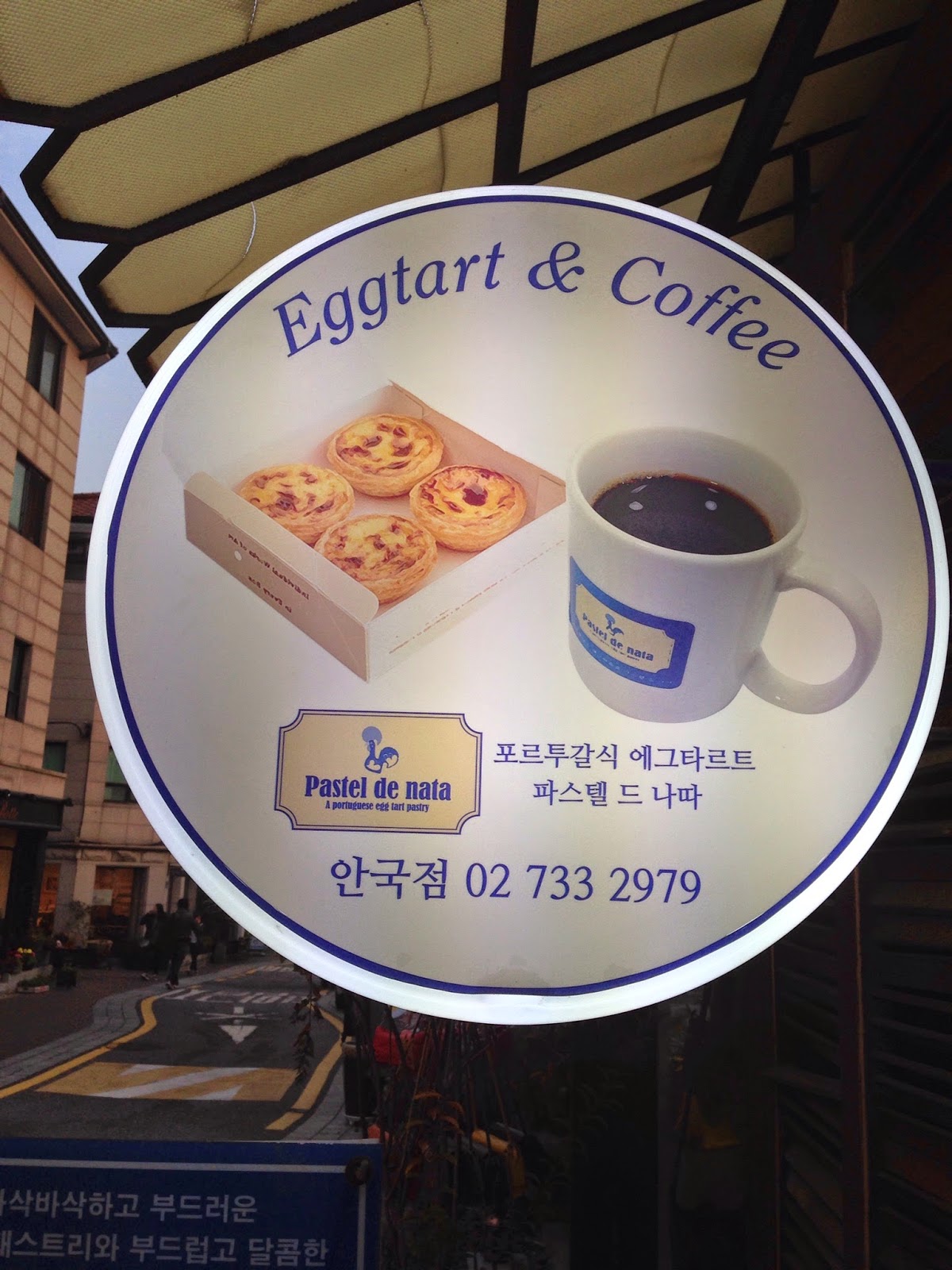
We have also discovered in the meantime that it's possible to buy Portuguese egg tarts (pastéis de nata) in Seoul. In fact there are several locations where they sell them. Although we do not crave the tarts that much, the discovery made us happy for some underlying nostalgic reason.

Portuguese egg tarts in Anguk-dong
Pastel de nata (egg tart)
We tried the shop in Anguk-dong. They not only have the classic egg tart, but also a few non-Portuguese variations: chocolate, walnut, apple cinnamon, lemon, pumpkin and sweet potato tarts. Price per tart is 3,500 KRW. Classic is 2,200 KRW.

To get there: from exit 1 in Anguk station, turn right and immediately right again. The shop will be on your left roughly 200 meters up the street.

This combined with the Manoel de Oliveira Retrospective being shown at the moment in Seoul Cinematheque makes 10,000 kilometers seem a hop, skip and a jump.

The cherry on top of the tart was finding out almost simultaneously that we will soon be able to eat  "açaí na tigela" just next door from us (Itaewon-ro 54-gil).

Açaí bowls: opening soon in Itaewon
Ok, we will not go wild on the açaí because we don't want to contribute to the Amazonian deforestation, but at least, Autumn just got a tad more interesting!